Thursday, 26 July 2018

David Bowie - The Glam Years

Success had come late to David Bowie in the Summer of 1972 when he made his famous appearance on Top Of The Pops singing Starman. This was three years after his first hit with Space Oddity which had coincided with the Apollo 11 moon landing. Following this his career had largely been on hold, with the release of The Man Who Sold The World and Hunky Dory LPs failing to at first make any great impressions on the pop buying public as a whole.

However, the album The Rise and Fall of Ziggy Stardust and The Spiders From Mars had been released the month previous to the TOTP performance and became his big breakthrough. Touring incessantly with his band of Spiders (Mick Ronson, Trevor Bolder and Mick “Woody” Woodmansey), Bowie as Ziggy took the pop world by storm for the next year before announcing that their performance at the Hammersfield Apollo in early July 1973 would be their last. The LP itself is a kind of concept album about an androgynous pop star who arrives from Mars (!?!) together with his band, rising to incredible fame before burning out in a big way. The title track offers clues to who Ziggy is based on, with Iggy Pop, Lou Reed, Jimi Hendrix and Marc Bolan all being definite candidates:


Three months prior to this Aladdin Sane had been released. Some critics though it a lesser album than Stardust and although it has some standout songs on it, yours truly has always tended to agree. Bowie described Sane as “Ziggy goes to America”, and most of its tracks are indeed reflections on the United States that were written when he travelled through the country on tour in late 1972. My favourite song is Panic In Detroit where the dive bombing guitar of Mick Ronson and the frantic singing of Linda Lewis and Juanita “Honey” Franklin add lustre to Bowie’s Bo Diddley beat tale of John Sinclair and recent riots in the Motor City:


.  


The American pianist Mike Garson contributed greatly to this album and would become one of David’s main collaborators over the next four decades. The Spiders, however, had fractured by the time Bowie’s next LP Pin Ups was released with Mick Woodmansey replaced on drums by Aynsley Dunbar. An album of cover songs by British bands from the 60s, it was noticeable for the striking cover photo featuring David and the gorgeous Twiggy.

By the time of Diamond Dogs release in 1974, all remaining Spiders had gone. Bowie played guitars, saxophones and keyboards in his own raucously energetic style along with top session musicians on other instruments. The album’s theme was a cross between George Orwell’s 1984 and Bowie’s own post apocalyptic vision, with the Sweet Thing/Candidate/Sweet Thing(Reprise) section being particularly brilliant musically and lyrically:


I think it was Charles Shaar Murray of the New Musical Express who remarked at the time that the single Rebel Rebel was the final hit being played in the last discotheque left in the ruins of the city. Diamond Dogs was a fitting end to David Bowie’s Glam years. His next move would be to soul and funk and America, before ending up in Berlin. Here is that aforementioned “final hit song”:  


Wednesday, 25 July 2018

Rebel Rebel


David Bowie’s farewell to Glam. Young Americans, Station To Station and the Berlin “Trilogy” would follow, but this is where Ziggy said farewell 😊

Monday, 23 July 2018

Soul Survivors

In the end, there was The Stones. The Beatles had split, Ray Davies of The Kinks was to soon say he had had enough and The Hollies had fractured.

Musically, Exile On Main St. in many ways was where the Sixties ended and the Seventies began. Released in 1972 only three years after Brian Jones had died, it is a  testament to the rest of the band’s survival of the previous decade. In Britain, Marc Bolan was riding the crest of the wave and David Bowie was about to become famous when the Rolling Stones finest LP hit the shops and stores. I remember buying the New Musical Express when the flexi disc featuring tracks from the upcoming album was offered free with the periodical,  Around the same time, Tumbling Dice rose up the singles chart.


A sprawling and at first seemingly ramshackle double LP – Exile had actually passed me by when it came out. I’d thought that Tumbling Dice was the best single they’d ever made but being in the middle of my Beatles/Glam Rock stage, Telegram Sam and Strawberry Fields were the songs most regularly on my turntable. However, in ’73 or ’74 Nick Kent wrote a massive re-appraisal of the album in the NME which had apparently had mainly lukewarm reviews in many music papers on its release. He called it the Stones’ finest hour. That was enough for me to go out and get it.
Side one starts with Rocks Off and Rip This Joint, two high octane rockers.  Apart from the songs and energy, it was immediately noticeable that the brass section of Bobby Keys and Jim Price added to and enriched the overall sound.  Shake Your Hips keeps the energy level high before Casino Boogie recalls the blues origins of the band. Dice ends the side and is still their greatest ever single release. Sweet Virginia begins a Side Two which is more country tinged with Torn and Frayed and Sweet Black Angel (referencing Angela Davies) being my favourites of the four featured songs. Loving Cup ends the fist disc in a somewhat earthy yet also slightly spiritual way.


The second LP starts with Keith’s Happy which rocks along really fine. Turd On The Run and Ventilator Blues are both unsettling yet compelling songs before we reach the ethereal I Just Want To See His Face. From here on in, the LP just gets better and better.  Let it Loose rounds off side three and is one of the band’s finest ever moments.  It grows from slow beginnings to a truly uplifting and almost spiritual climax with Tami Lynn, Dr John (who also plays piano on the song),  Clydie King, Vanetta Field, Shirley Goodman and Joe Green providing backing vocals to Mick’s soulful lead singing.


The final side begins with All Down the Line, one of their greatest rockers.  Robert Johnson’s Stop Breaking Down is next with Mick Taylor on incredible slide guitar and the other Mick on harmonica.  Shine a Light features one of Mick Taylor’s finest performances on lead guitar and the album ends with Soul Survivor. which takes the energy level to the outer limits. Jagger wails, Keith’s rhythm cuts right through and Charlie just keeps on keeping on.

From then on, there would be a noticeable decline in the band's music. Much of the following album Goats Head Soup was second rate Stones, and although It's Only Rock n Roll was a better LP, Mick Taylor left the band on its completion complaining that he had not been given song writing credits for the fantastic Time Waits For No One. Ronnie Wood was his replacement and while the group has made some excellent songs since then, the late 60s and early 70s remains their peak.

Never bettered by the band, Exile stands as one of Rock n’ Roll’s greatest achievements.

Tuesday, 24 October 2017

I Believe in Miracles


Brian Clough.  Iconoclast, genius, mischief maker, football manager.  I first remember Brian as Derby County manager at the end of the 1960s when together with Peter Taylor, he set the football world alight with an exciting youthful team who gained promotion from the second division.   Clough's most important early signing was the wonderful Dave Mackay who played as sweeper and captained his younger teammates to the First Division title in 1972.

The club reached the semi-finals of the European Cup in 1973, but amidst much controversy they lost out to Juventus.  Like most football fans, I was astonished when Clough and Taylor left Derby later that year and went south to Brighton.  Even more amazing was the news in 1974 that Brian was replacing Don Revie as Leeds United manager.  Clough had lambasted the club and Revie for cheating their way to success, so it came as little surprise when he and Leeds parted ways after just forty-four days.  Tellingly, Peter Taylor had remained on the south coast when Brian went north.

In January 1975, Clough became the manager of Nottingham Forest who were then a mid-table second division club.  Eighteen months later, the dynamic duo were reunited when Peter Taylor came to the City Ground and things really did begin to move.  Forest were promoted to Division One in 1977 and then took the top flight by storm and became League Champions the next year.

The European Cup now came back into Clough's life, and after beating the holders Liverpool in the first round, Forest kept on going and reached the final following a tight two legged semi-final against Cologne.  Malmo awaited in Munich.  The final was a tense affair, settled by a headed goal from Trevor Francis who was making his European debut following his million pound transfer from Birmingham City earlier in the season.  The 1979-1980 season saw Forest retain the trophy against Hamburg in Madrid.

That was the peak of Clough and Taylor’s career together.  Peter left Forest to retire in May 1982, only to come back to manage Derby County seven months later.  Brian and he sadly fell out the following year over a player’s transfer and never spoke to each other again.  Meanwhile, Forest continued as one of the top First Division teams throughout the 1980s, but never again approached the peaks of the late 1970s.  By the early 1990s, Brian was struggling with alcoholism and Forest were relegated from the Premier League in 1993 and Brian Clough retired from football management.

Peter Taylor had died in 1990 and Brian Clough cried when he heard the news, and attended his old friend’s funeral.  Brian finally underwent a liver transplant in 2003, but died the next year from stomach cancer.  So ended the life of a true footballing great, and although far from perfect, Brian Clough really did help so many of us believe in miracles.


Monday, 9 October 2017

Everybody Dance 😊

Image result for nile rodgers

Chic have been one of the greatest groups around for the past forty years.  Nile Rodgers has been leading the band since they were formed and what fantastic music he has made.

I first recall hearing Chic in 1977 when Dance, Dance, Dance was a hit. It was followed by a succession of great singles such as Everybody Dance, Le Freak, I Want Your Love and the era defining Good Times in 1979.  I had the pleasure of seeing Chic live in the Autumn of 1979 at the Liverpool Empire and they were absolutely fantastic.  Along with The Beatles in Llandudno in Summer 1963, this remains my favourite of all concerts.

Nile had Bernard Edwards on bass and Tony Thompson on drums on stage with him that night as well as many other contributors to what had become known as the Chic Organisation.  The string section of the group made their disco/funk/ pop sound even more unique and people were dancing in the aisles all evening long.

Fast forward a few months and Rapper's Delight by The Sugarhill Gang was all over the airwaves.  At the time (like Nile Rodgers apparently) I did not appreciate the song.  In fact, Rodgers and Edwards threatened legal action over copyright but settled when they became credited as co-writers.  Again, similar to Nile, over the years the song has grown and grown on me and it is now one of my (and his) favourite songs and of course was instrumental in introducing hip hop to the public at large.

The 1980s saw Nile as one of the decade's top producers with artists as diverse as David Bowie, Duran Duran and Madonna.  By the time the 1990s was with us, I had lost touch with the popular music scene to some extent, but remember the shock when reading that Bernard Edwards had died of pneumonia following a concert in Japan in 1996.

This century has seen Nile touring with Chic, including two magnificent performances at Glastonbury over recent years.  He has also survived prostrate cancer and contributed to Daft Punk’s Random Access Memories album.  Nile Rodgers is one of my all time musical heroes and here is the song inspired by Nile and Bernard being refused entry into Studio 54 on New Year’s Eve 1977:


Sunday, 16 April 2017

Remembering John Wetton

I have only recently become aware about the sad passing of John Wetton earlier this year on 31st January. 


He was a great singer, songwriter and bass guitarist with a number of bands including Family, UK and Asia.  However, I first became aware of John when he joined King Crimson in 1972 and contributed to their fine LPs Lark's Tongue In Aspic, Starless and Bible Black, Red and U.S.A.  This was for me the best line up of Crimson due in no small part to the rhythm section of John and Bill Bruford.  Stand out songs from this era include Easy Money, Exiles, Book of Saturday, The Night Watch, Fallen Angel and the incomparable Starless.

As previously mentioned, John was involved with other bands and musicians until he lost his fight against cancer.  Thank you so much for all the wonderful music that meant (and means) so much to me John.


Thursday, 13 April 2017

World Cup 1978

Argentina, Summer 1978. The World Cup had come to South America for the first time in sixteen years.  England had again failed to qualify following the Don Revie years, despite rallying under Ron Greenwood and Scotland were again the sole British representatives this time due to a highly contentious win against Wales at Anfield in Liverpool.


Favourites for the competition included the host nation, Brazil, West Germany, Italy and The Netherlands.  There were fears before the tournament of possible threats to players and the great Johan Cruyff refused to take part apparently due to a plot to harm his family if he did play.

Although therefore diminished, the runners up from four years previously again played some of the best football of the competition, especially in the second group stages.  However, we are getting ahead of ourselves, so let us start from the beginning.  The tournament kicked off on 1st June when the defending champions West Germany met Poland in a 0-0 draw in Buenos Aires.  The Germans looked solid, but many of their stars from 1974 were gone (including Frank Beckenbauer and Gerd Muller) and the team lacked flair in many key areas.
Image result for West germany poland 1978


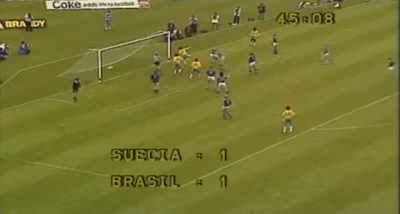
The first group stages established Italy as a strong and skillful side and Brazil emerged as a much less physical team than the one who had muscled their way in West Germany four years before, showing more finesse this time.  At this point, the name of the Welsh referee Clive Thomas comes into our tale.  Brazil were playing Sweden in the first game of Group C and the score was 1-1 with 90 minutes  almost up when they gained a corner.  Nelinho was forced to re-spot the ball by the linesman before bending a right footed kick right onto Zico's head who powered it into the net.  Brazilian celebrations were short lived, however, as Mr Thomas dramatically disallowed the "goal" stating that he had blown the full time whistle before Zico had met the ball.  This result had repercussions later on in the group when Brazil finished as runners up to Austria on goal difference, so progressing to the same second round group as Argentina and a certain Peruvian team...

Image result for brazil sweden clive thomas


Peru had "shocked" Scotland in Group D with a 3-1 victory, but those of us who remembered how well they had played in Mexico in 1970 with their star player Teofillo Cubillas still present were not quite so surprised.  The Netherlands ended Ally MacLeod's side's hopes in that Group's final game by losing only 2-3 so the Dutch ended up progressing into the second round.

In Group One, The Netherlands just pipped Italy to the top, courtesy of some truly spectacular goals from Arie Haan and Johnny Rep in particular.  Group Two featured Argentina, Brazil, Poland and Peru.  With one game left, Argentina needed to beat Peru by at least four clear goals.  Peru had acquitted themselves in the first round rather well but had lost to Poland and Brazil in this group.  However, a 6-0 victory to Argentina raised suspicions that certain pressure had been placed on the Peruvians to allow the home nation passage to the final which years later appeared to be confirmed.  The Peru goalkeeper Quiroga (nicknamed "El Loco") had indeed shone in the first few games with frequent excursions to the half way line, but he seemed particularly below par in this notorious game.

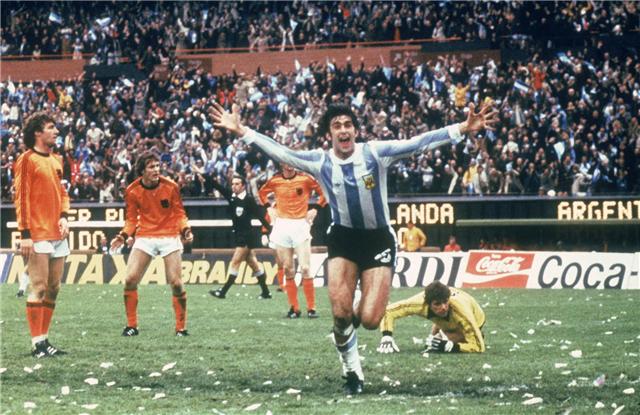
And so, on 25th June, Argentina and The Netherlands met in Buenos Aires.  It was an ill tempered affair with Mario Kempes putting the South Americans ahead just before half time and Dirk Nanninga equalising with 8 minutes remaining.  With literally seconds left, Rob Rensenbrink hit the post and with that, Dutch hopes were dashed.  Kempes and Bertoni confirmed Argentina as champions in extra time and the South Americans became World Cup winners for the first time.  For The Netherlands, the golden age of the Seventies had come to an end, but as we shall see, a decade later they would end up as European champions with another great team.

Image result for argentina v netherlands 1978